
What color should I paint my living room?
By Goodesign AI · Updated 2026-10-16
For most living rooms, start with a warm neutral — soft white, warm greige, or pale clay — because it flexes with seasons, furniture, and resale. Add color through textiles and art, which are cheap to change, rather than walls, which are not.
The honest answer is that the best living room color depends on three inputs: the light your windows actually deliver, the fixed elements you can't change (floor tone, fireplace stone, kitchen sightlines), and how often you like to rearrange. Here's how to decide rather than guess.
Start with your light
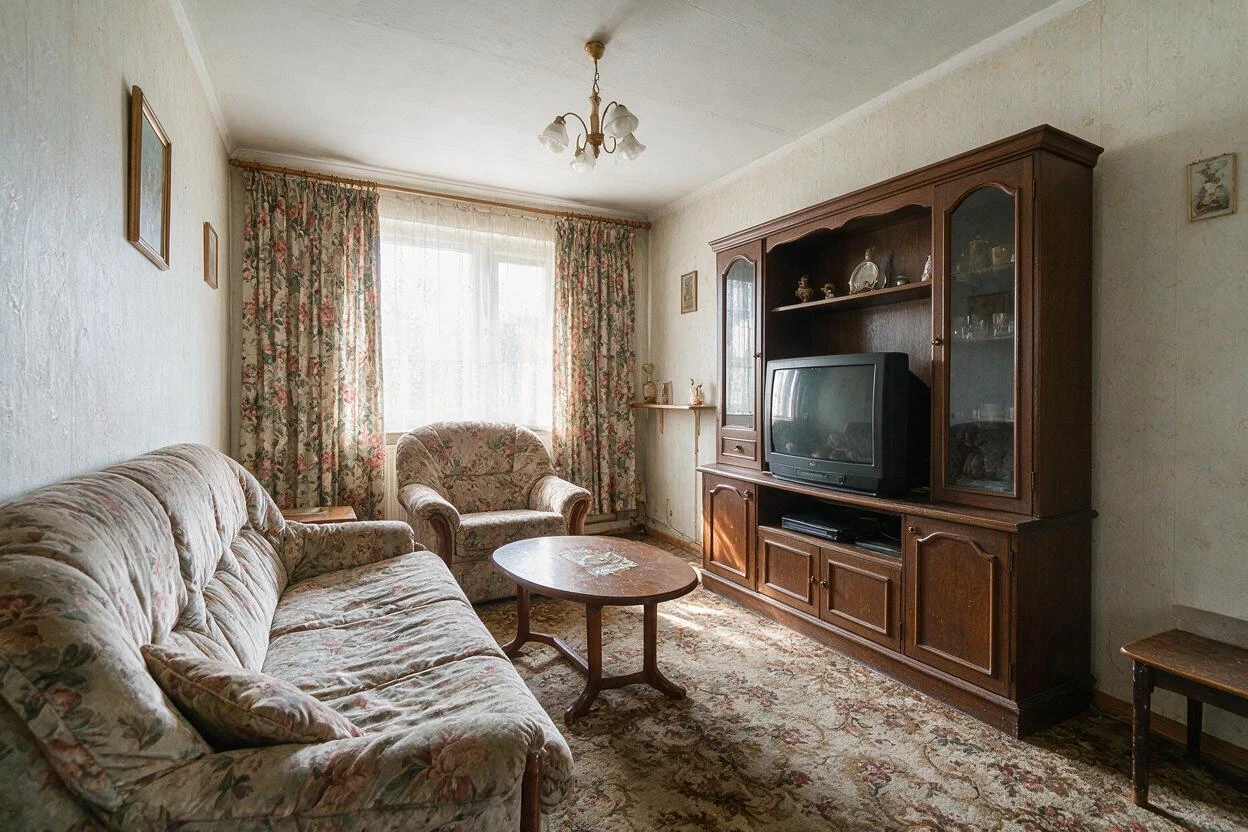
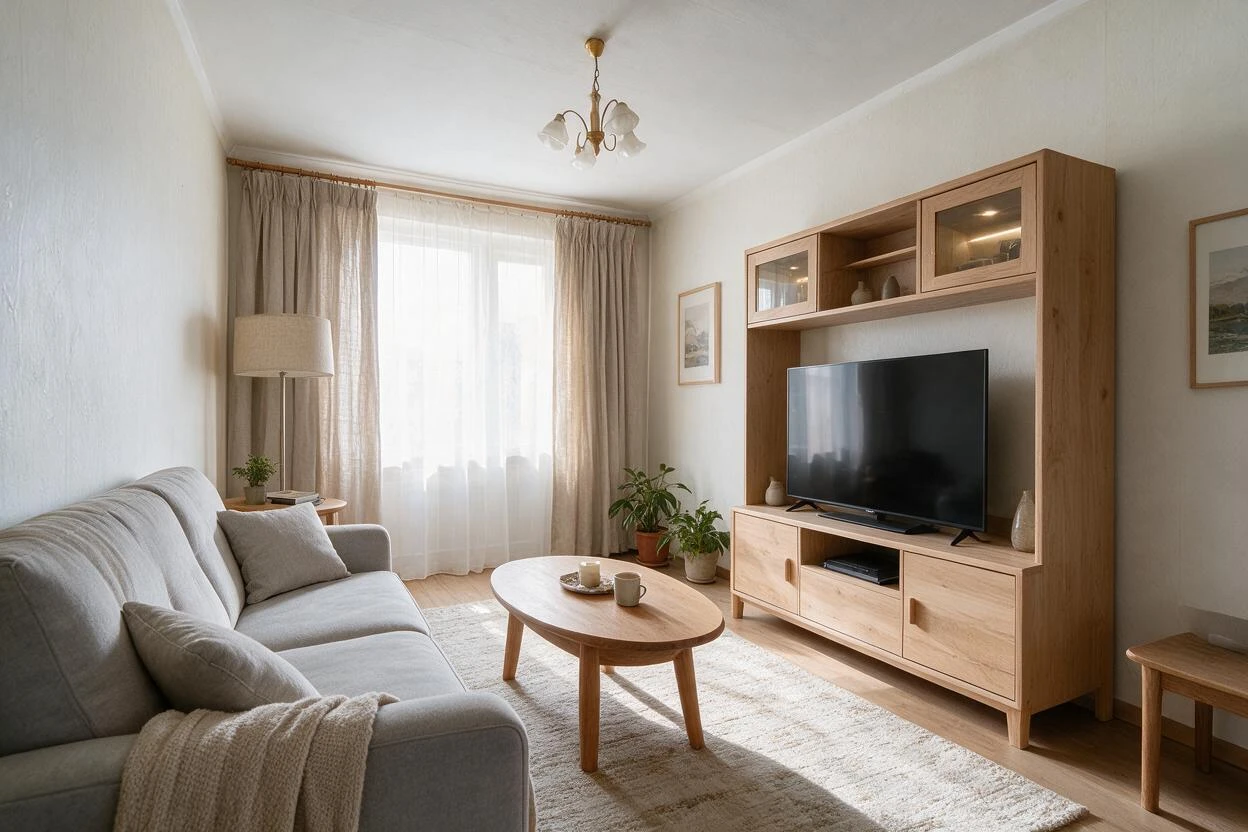
North-facing rooms receive cool, indirect light all day — warm neutrals (creams, warm greiges, soft clay) counteract the chill. South-facing rooms get strong warm light and can carry cooler or deeper colors (sage, slate blue, even deep green) without feeling gloomy. East and west rooms shift between warm and cool across the day, so true neutrals are safest.
The same advice, arranged for a quick lookup:
| Window | Light it delivers | Colors that work | Colors that fight it |
|---|---|---|---|
| North | Cool, indirect, steady all day | Creams, warm greiges, soft clay | Cool grey and stark white, which turn colder still |
| South | Strong, warm, abundant | Sage, slate blue, deep green — depth without gloom | Barely-tinted whites, which wash out |
| East | Warm bright mornings, flat afternoons | True neutrals that tolerate both moods | Anything judged at 9 a.m. only |
| West | Pale mornings, golden evenings | True neutrals; deeper tones if evenings dominate | Judging the swatch only in the morning light |
Respect the fixed elements
Oak floors pull yellow-orange; anything you paint should be tested against them, not against a white paint-chip background. Gray walls next to honey oak read pink. Warm whites next to walnut read balanced. This is why paint picked from a catalog so often disappoints on the wall — the catalog doesn't contain your floor.
It's also why the same color can look right in one room and wrong in the identical room upstairs: bulbs, exposure, and sheen all bend it. If a swatch keeps misbehaving, why paint looks different on the wall than in the store explains most of the mystery.
Decide what role color plays in your life
If you restyle often, keep walls quiet and push color into pillows, curtains, and art — cheap to swap. If you hate redecorating, put the character on the walls and keep furnishings neutral; a well-chosen wall color stays satisfying for a decade.
The reliable shortlist
Warm white (spaces feel larger and cleaner), warm greige (cozy and forgiving), pale clay or blush (warmth without pink), sage (calm, works with wood), deep charcoal-green for a single accent wall (drama without whole-room risk).
Room-by-room colors backed by Zillow research
If resale is anywhere in your next five years, it helps to know what buyers' eyes actually did. In Zillow's 2026 paint color analysis — a survey of thousands of US buyers shown rooms in different colors — the living room told a clear story: a pale, misty blue, Sherwin-Williams Tradewind (SW 6218), was the top performer, with buyers saying they would offer an estimated $1,723 more than for the same room in white. A deep charcoal grey (Peppercorn, SW 7674) trailed at about $1,509, and a soft sage green (Livable Green) added a smaller but real $471. Sage was also the only color family that ranked near the top in every room of the house.
Read the numbers as direction, not promise: this is a study of what buyers said they would do, which is correlation wearing a lab coat. But the pattern is useful — every winner is a muted, greyed-down color that photographs calm, which is exactly the quality the resale-focused neutral paint guide builds a whole palette around. The 2021 edition put it more bluntly: Zillow's listing-photo analysis found homes with light blue bathrooms sold for up to $4,698 more than expected — phrasing that matters, because it compares sale prices against predictions rather than promising any house a bonus.
Colors that cost you money
The expensive living room colors aren't the ones buyers dislike — they're the ones you repaint in two years. A saturated color chosen from a mood board in winter can feel loud by the second summer, and the trend cycle moves faster than painters do. The cheap test: if the color's appeal depends on the styling around it (a specific rug, a specific art wall), it has a shorter shelf life than one that works with bare walls and your actual furniture.
The second cost is resale friction. The same 2026 survey flagged bold red, ochre yellow, and blush pink as the colors buyers discount hardest in other people's houses — a red bathroom was associated with offers roughly $7,971 below the white equivalent. A red living room lives in the same family of risk. If you must have the drama, buy it in a chair.
Specific paint swatches to shortlist
The shortlist above, translated into names and numbers:
- Warm white: Benjamin Moore White Dove (OC-17) or Sherwin-Williams Alabaster (SW 7008) — the reliable "larger and cleaner" choice.
- Warm greige: Sherwin-Williams Agreeable Gray (SW 7029) or Benjamin Moore Revere Pewter (HC-172) — cozy and forgiving of clutter.
- Pale clay/blush: Benjamin Moore First Light (2102-70) — warmth without pink-doll territory.
- Sage: Sherwin-Williams Evergreen Fog (SW 9130) or Benjamin Moore October Mist (1495) — calm, and the family that rated best across Zillow's whole study.
- Deep accent for one wall: Benjamin Moore Hale Navy (HC-154) or Sherwin-Williams Peppercorn (SW 7674).
- Trim: Sherwin-Williams Pure White (SW 7005), a half-step brighter than the walls.
Accent walls, dark colors, and other calculated risks
An accent wall earns its keep when it frames something the room already wants you to look at — fireplace, TV wall, the view window — and fails when it just quarantines one color. If you're weighing one, whether accent walls still work covers the current verdict. Dark colors follow the same logic at higher stakes: they need light to spend, and small rooms pay the price first.
Whatever direction you're leaning, test it in your own light before buying gallons: upload a room photo and render your shortlist side by side — free.
FAQ
What is the most popular living room color?
Warm off-white and greige still dominate — Sherwin-Williams Agreeable Gray has been among the most-specified paints in the country for a decade. The resale data adds a twist: in Zillow's 2026 buyer survey, a pale blue living room rated above white.
What colors make a living room look bigger?
Light, warm colors with low contrast do the most work: walls and trim within a step of each other, ceiling lighter than walls, rug pale. High-contrast schemes slice a room into zones and shrink it.
Should my living room match the hallway?
Connected sightlines want continuity — same color at best, same color family at minimum. A living room that clashes with the hallway you pass through to reach it feels cramped exactly at the seam.
Does paint color really affect resale value?
It correlates with it. Zillow's surveys find buyers offering estimated premiums for certain room-color pairings — pale blue living rooms about $1,723 over white in the 2026 study — but nobody repainted identical houses and ran the experiment twice. Choose what photographs calm and treat the dollar figures as directional.
Compare
Related questions
Related tool
