
Is virtual staging worth it when selling?
By Goodesign AI · Updated 2026-10-16
For most empty or dated listings, yes: virtual staging costs a small fraction of physical staging, finishes in days instead of weeks, and materially improves how rooms read in listing photos. It's worth most when the alternative is a cold, empty gallery.
The case for virtual staging comes down to three numbers: cost, speed, and click-through. Two of those numbers have collapsed in the last few years. The third was always in your favor.
Cost

Physical staging runs roughly $2,000–5,000 per property for furniture rental and design labor, per month in many markets. Virtual staging prices per photo. For a typical three-bedroom listing, the virtual route often costs less than one month of one staged room.
The sourced versions of those numbers: HomeGuide's survey (quoted secondhand by HomeLight) puts traditional staging at $1,500–4,000 for the first month, and NAR's 2025 Profile of Home Staging puts median staging spend at $1,500. Against that, a six-photo AI gallery costs somewhere between $0 and $150. The full math lives in what virtual staging costs.
Speed
Furniture delivery, installation, and removal take weeks and depend on inventory. Virtual staging takes a day. If your photographer is already booked Thursday, Thursday is enough.
In practice it's faster than that. A generated render takes 15–30 seconds, so "a day" really means "one sitting." The scheduling dependency disappears — you're waiting on your own coffee, not a truck.
Effect
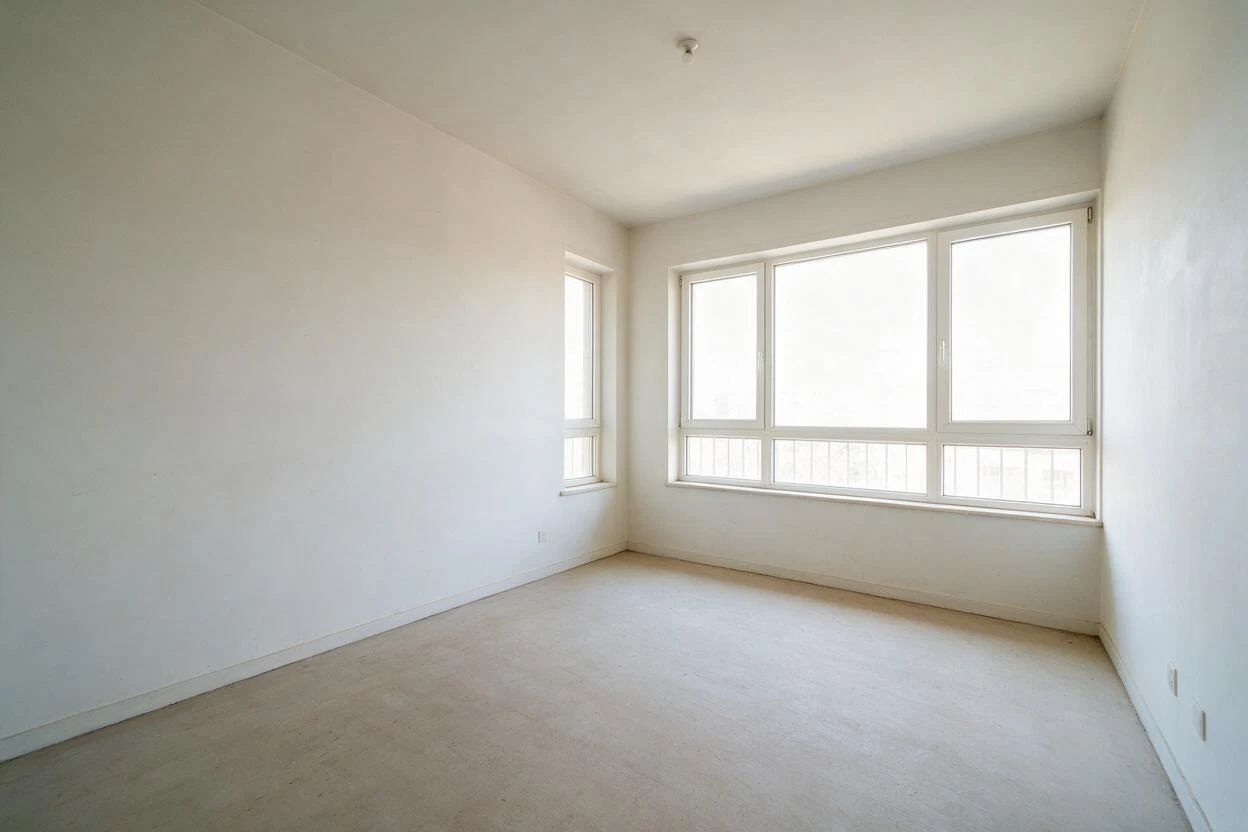
Empty rooms are the worst-performing images in any listing gallery. They give no scale, no warmth, and no story — and buyers skip them or worse, assume something is wrong. Staged images (disclosed as virtual) consistently hold attention longer, and attention is the currency of listing platforms.
NAR's 2025 survey gives that some structure: 83% of buyers' agents said staging makes it easier for buyers to visualize the property as home, and 73% cited the importance of listing photos. Buyers decide from photos, and an empty room photographs as a floor plan.
What the 2025 NAR data actually says
The honest summary of NAR's 2025 Profile of Home Staging, a survey of 1,266 agents:
- 49% of sellers' agents said staging shortens a home's time on the market.
- 29% of sellers' agents said staging increases offers by 1–10%.
- 83% of buyers' agents said staging helps buyers visualize the home.
- Median staging spend: $1,500.
Read the caveats before the headlines. These are agent opinions, not a controlled experiment, and the survey covers staging broadly — mostly physical. Virtual staging inherits the mechanism (better photos, easier visualization), not the exact percentages. Directional, not magical.
The math on a $500,000 listing
Physical staging: $1,500–4,000 out the door before the first showing. To break even, the listing needs a 0.3–0.8% price lift or a meaningfully faster sale. Plausible — agents who stage regularly believe it — but it's a real bet placed with real furniture.
Virtual staging: $0–150, finished in an afternoon. The break-even threshold is a rounding error; one-tenth of one percent of the price covers it many times over. That asymmetry is the whole argument. Physical staging needs the market to cooperate. Virtual staging needs almost nothing.
The honest downsides
Three, in order of how often they bite. First, quality ceilings: complex angles, staircases, and luxury finishes are where AI output still looks generated, and a bad render is worse than an empty room. Second, trust: a render that doesn't match the room's real windows and proportions reads as deception even when it's innocent — we drew that line carefully in does virtual staging mislead buyers. Third, the evidence for virtual specifically is thin; you're reasoning from the physical-staging literature plus your own before/after click data. Reasonable. Just say so honestly.
When it's NOT worth it
If the home is occupied and well-furnished, you don't need staging — you might need light decluttering or a restyle instead. If your market's buyers are famously skeptical of digital edits, factor that in and disclose clearly. And if the property is a luxury listing where buyers expect magazine-grade everything, budget for physical staging; virtual work reads best at mid-market price points.
Do it right
Disclose per your MLS rules. Stage for the target buyer, not for your taste. Keep renders consistent with the room's real architecture — nothing breaks trust faster than a window that exists only in the render.
The rules are tightening, too. California's AB 723, effective January 1, 2026, requires disclosure when listing photos are digitally altered. Even where you're not yet required to, caption virtual rooms "virtually staged." It costs nothing and pre-empts the one objection that kills trust at a showing.
Curious what your listing would look like staged? Upload a room photo and get a free staged render before committing to anything — or see what the tool does with a room like yours first.
FAQ
Do staged homes really sell faster?
Probably, though the evidence is survey-based: 49% of sellers' agents in NAR's 2025 report said staging shortens time on market. That's opinion rather than a controlled study, but it repeats across surveys — and staged rooms also earn more photo clicks, which drives showings on its own.
Does virtual staging mislead buyers?
Not when it's disclosed and the render stays true to the room's actual architecture. What misleads is silent alteration — inventing a view, erasing a power line, implying furniture conveys. Caption the image "virtually staged," keep walls and windows honest, and there's nothing to defend.
Is virtual staging worth it for an occupied home?
Usually not. A furnished, lived-in home needs decluttering, lighting, and better photography more than inserted furniture. Virtual staging earns its keep on vacant or dated listings, where the alternative photo is an empty or worn-out room.
Who pays for virtual staging — the agent or the seller?
At today's prices, nobody negotiates: it costs less than the photography and gets budgeted the same way, as the agent's marketing spend. At service-era prices of $20–70 per photo it was worth a conversation. At $0–3 a render, it isn't.
How many photos should I stage for it to pay off?
Four to eight per listing is the usual range, and a three-bedroom usually needs all of it. Stage the rooms that photograph empty — living area, primary bedroom, and any awkward space. Staging twenty images for a condo is spend without extra return.
Does virtual staging work for cheaper homes?
It works hardest there, because cheap listings are exactly where photos are weakest. At cents to a few dollars a render, cost is no longer the constraint; the constraint is that staging cannot rescue a wrong price, so set the price first and stage second.
What is the cheapest credible workflow?
Phone photos shot level at chest height with the lights on, staged with AI in one pass, labelled as virtually staged, and reshoot the two or three weakest frames. That is $0–3 per image including regenerations, and it beats a $30 human photo of a badly shot room.
Related questions
Related tool
